Author Archives: postnearlypress

THE ACCIDENTAL ARCHIVE – a despatch from the edgelands

The Accidental Archive – 46 pages of original content compiled by Julian Hyde for www.voicesinalane.co.uk

Full colour A4 magazine on 120gsm paper. Print only. Prose/Poetry/Image. Features new work from Alasdair Maclean; Nick Papadimitriou; Richard Skelton; Julian Hyde. Features Walkway to Nowhere, an exclusive feature-length piece by Neil Jackson with illustration by Craig Turnbull.

Hyde


Price GBP 10.00 incl postage within the U.K
First 50 copies include 5 limited edition 5×7 postcards
For enquires/orders/Paypal details please email Julian@voicesinalane.co.uk

FILM WITHOUT FILM – CHRIS PETIT IN CONVERSATION is available now

fwf

Chris Petit in conversation. Compelling insight into Petit’s work, methods and creative outlook; engaging content on his collaborations and history with Iain Sinclair.

54 pages of original content; stab-stapled; straw, snow and jute recycled paper; colour cover; inner content double sided; trimmed short of A4.

Price GBP 8.50 (including postage within the UK). For postage costs to USA, Europe, South America, South Africa etc – please email.

For enquiries/orders please send an email to postnearlypress@gmail.com

Normal payment method is Paypal – payments against the email address above. Please put delivery address on the transaction details. Cheque payments – this is fine; please email.

See also the first in the series:

itiod


http://www.postnearlypress.com


FILM WITHOUT FILM – extract

An extract from the forthcoming Film Without Film; Chris is discussing some of the ideas behind his cult 1979 road movie Radio On.

NJ: Radio On has this ostensible plot which seems to dissolve. And this leads on to the concept of drift: abandoning the car and taking a train to nowhere; The Hard Shoulder with O’Grady in his car heading for a tunnel – yet we don’t really know where he’s going; characters end up in this state of drift. Cookie in Robinson is an opportunistic drifter. Incidentally is he partially based on Derek Raymond/Robin Cook?
CP: I thought of Raymond, or Cook – and I had cousins who were a bit like him – as a kind of upper class ne’er do well. There’s normally some short-service commission involved.

There’s always charm, however. The ability to carry it off; to win you over. I believe Raymond was a very charming man.
Extremely charming. But of course charm can be used as an offensive. The drift in Radio On came about, in a way, by default. The problem I had with English drama and cinema was that it was so structured around class. I didn’t want to make a film about English class. I wanted to make a film about space and movement and weather and music; and not about class.

It still comes through very strongly in British TV and cinema.
That whole area of English sit-com is completely structured around class. So I thought that if the film was going to look ahead at all, it would have to be different to that. One of the things that make it different is that it’s about technology. Radio On is partly about that whole Kraftwerk thing. It clarified what the film was about. Airwaves; communication. It’s not about what Mike Leigh makes films about. And also I thought – which has both happened and not happened – I thought that the class system would flatten out. It has done, but at the same time everything has become much more entrenched. You only have to look at the Daily Mail to see that. As part of a Museum of Loneliness project I said that I would cover the World Cup, and I would read the Daily Mail for as long as the World Cup went on. And it was unbelievable.

You’re a Norwich City fan, I’m informed.
In as much as I lived there when they were in the third division and got to the semi-final of the FA Cup. I’ve been stuck supporting them ever since. In Radio On I took the football results from a particular weekend at the time, but I reversed the score line for Norwich. So
it says Norwich 1 Chelsea 0. In reality, however, it was Chelsea 1 Norwich 0.

FILM WITHOUT FILM – CHRIS PETIT IN CONVERSATION

Film Without Film – I’m pleased to say this item is in the production/preparation stages. Publication currently looking like March. This is an extremely generous and substantial interview by Chris that covers just about all of his major work at length, while pointing at future work and ideas. As one would expect, there is a significant Iain Sinclair crossover. Also, I’d say it’s a particular must for fans of Chris’s novels The Hard Shoulder and Robinson.

cropped-pnp.png

EARLY 2015 – CHRIS PETIT IN CONVERSATION

Slightly later than originally planned, but I’m delighted to give notice that the next Post-Nearly Press ‘conversations’ publication is planned for early 2015. And I’m especially pleased to say film-maker, writer and artist Chris Petit is the subject.

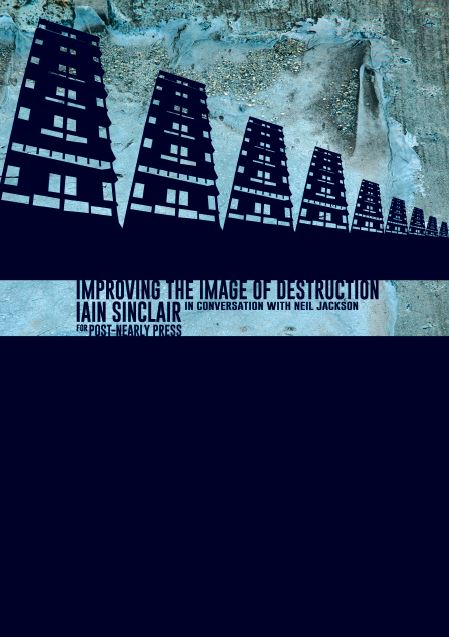
PNP2 will be in the same vein as PNP1, the Iain Sinclair publication – Improving the Image of Destruction, with more in the ‘conversations’ series planned for the future.

Scenario for publication is the same: It will be a print-only item, limited in number and won’t be published on the internet.